


Warp Zoned Presents

 Video Game Canon
- Clair Obscur: Expedition 33 Has Another Big Night and Wins “Game of the Year” at the 2025-2026 DICE Awards
- 2025 GOTY Scoreboard: In Progress
- The Game Awards: All the Winners from 2003 to Today
- Clair Obscur: Expedition 33 Racks Up Nine Wins, Including “Game of the Year”, at the 2025 Game Awards
- “Animal Crossing” and Undertale” Lead the Way for New Book Series About Games at University of Chicago Press
Warp Zoned Presents

- Video Game Research Library
- We Pitched a Museum a 1993 Game Hint Line (And They Actually Said Yes) – Yarn Spinner (2026)
- The History Of The Word “Metroidvania” And How It Spread – A Critical Hit (2025)
- Creator of Hit Game Shovel Knight Is at a ‘Make or Break’ Moment – Bloomberg (2025)
- Shadow of the Colossus: An oral history – Design Room (2025)
- In 2005, games started rewiring our brains – The AV Club (2025)
All Articles: Game Boy Advance
See how many systems Nintendo has sold since they started selling systems
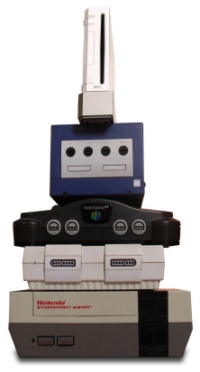 Nintendo has been in the video game business for a long time. Longer than Sony, Microsoft, Sega, Activision, Electronic Arts… nearly everybody actually. So it stands to reason that the company has sold a lot of systems and a lot of software. How much? Well, I’m glad you asked.
During their most recent quarterly financial briefing, Nintendo revealed lifetime-to-date sales figures for all of their consoles and handhelds. Some of the numbers may surprise you:
Hardware Sold
- DS: 151.52 million units
- Game Boy/Game Boy Color: 118.69 million units
- Wii: 95.85 million units
- Game Boy Advance: 81.51 million units
- NES: 61.91 million units
- Super NES: 49.1 million units
- Nintendo 64: 32.93 million units
- GameCube: 21.74 million units
- 3DS: 17.13 million units
All Software Sold
(Includes Nintendo-Published and Third-Party Titles)
- DS: 900.31 million units
- Wii: 818.46 million units
- Game Boy/Game Boy Color: 501.11 million units
- NES: 500.01 million units
- Super NES: 379.06 million units
- Game Boy Advance: 377.52 million units
- Nintendo 64: 224.97 million units
- GameCube: 208.57 million units
- 3DS: 45.42 million units
All sales data is based on worldwide totals and is accurate as of March 31, 2012. Italics indicates currently available system.
Posted in News
Tagged 3DS, DS, Game Boy, Game Boy Advance, GameCube, NES, Nintendo 64, Super NES, Wii
Zelda Producer: Gameplay comes first, where a game fits in timeline is a coincidence
 You didn’t think the arguments over the Legend of Zelda’s official timeline were over did you?
After revealing the official timeline to the English-speaking world, GlitterBerri has continued to translate Hyrule Historia on a page-by-page basis. Through her (and her team’s) work, she has discovered that the official timeline is not quite the pre-planned story bible that some fans hoped it would be.
Instead, on page 238, series producer Eiji Aonuma falls back on the traditional Nintendo party line. He confirms that the gameplay hook of a Zelda game is created first and where it fits within the timeline is actually just a coincidence:
Chapter 2, “The Full History of Hyrule,” arranges the series in chronological order so it’s easier to understand, but from the very beginning, Zelda games have been developed with the top priority of focusing on the game mechanics rather than the story. For example, in Ocarina of Time, the first installment of the series I was involved in, the main theme was how to create a game with pleasant controls in a 3D world. Or in the DS game, Phantom Hourglass, the focus was having comfortable stylus controls. Finally, in the most recent game, Skyward Sword, we focused on an easy way to swing the sword using the Wii motion plus.
Thinking of that way of developing the games, it may be correct to say that the story is an appendix to that. I even think that setting Skyward Sword as the “first story,” was merely a coincidence.
So the bottom line is that “The Official Zelda Timeline” is nothing more than an after-the-fact creation used to make Hyrule Historia more enticing to fans. And that’s fine. The timeline as stated still fits together rather elegantly.
But I have to admit, knowing that there was never a plan does put a bit of a damper on the timeline. Especially since Skyward Sword had been billed as the “first story” in the Zelda series since it was announced.
Posted in News
Tagged DS, Game Boy, Game Boy Advance, GameCube, NES, Nintendo 64, Super NES, The Legend of Zelda, Wii
Official Zelda timeline is officially official
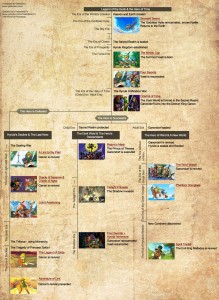
Behold, the official timeline of the Legend of Zelda franchise in all its translated glory (click to enlarge)!
With Hyrule Historia now available in Japan, Zelda translator extraordinaire GlitterBerri has unveiled a more complete English language version of the timelime, confirming the three-way split in the timestream. GlitterBerri also said that longtime Zelda producer Eiji Aonuma is listed as the Supervising Editor of Hyrule Historia, so that’s as close to an official stamp of approval as you can get.
Nintendo obviously isn’t going to stop making new games in the Legend of Zelda franchise anytime soon (in fact, a new Zelda game is in development for the 3DS as we speak), so it’ll be interesting to see where future titles fit into the timeline.
Posted in News
Tagged DS, Game Boy, Game Boy Advance, GameCube, NES, Nintendo 64, Super NES, The Legend of Zelda, Wii
Official Zelda timeline released by Nintendo
 Nintendo has gone all out for The Legend of Zelda’s 25th anniversary. In addition to the concert tour and multiple new game releases, the company has released a commemorative art book in Japan titled Hyrule Historia. Apparently, it also contains an official Zelda timeline sanctioned by Nintendo!
According to a fan translation at Kotaku, the timeline is actually comprised of three parallel universes, all of which are created due to Link’s actions during and after The Legend of Zelda: Ocarina of Time.
Are you ready to think fourth dimensionally?
If Link fails in his quest to defeat Ganon, the events of A Link to the Past come to pass. However, if Link wins the day, the timeline splits in two distinct ways. The Wind Waker branches off from the future timeline where Ganon ruled for seven years while Majora’s Mask follows on from OoT’s ending of Link back in his boyhood village.
So, when its all mapped out, the official timeline looks like this… (more…)
Posted in News
Tagged DS, Game Boy, Game Boy Advance, GameCube, NES, Nintendo 64, Super NES, The Legend of Zelda, Wii